In 1801, Thomas Young performed one of the most famous experiments in the history of physics. He fired light through two narrow slits and observed alternating bright and dark bands on a screen — the unmistakable signature of wave interference. Two centuries later, the same experiment performed with single electrons produces the same pattern, even when electrons are fired one at a time. Each electron seems to pass through both slits simultaneously, interfering with itself.
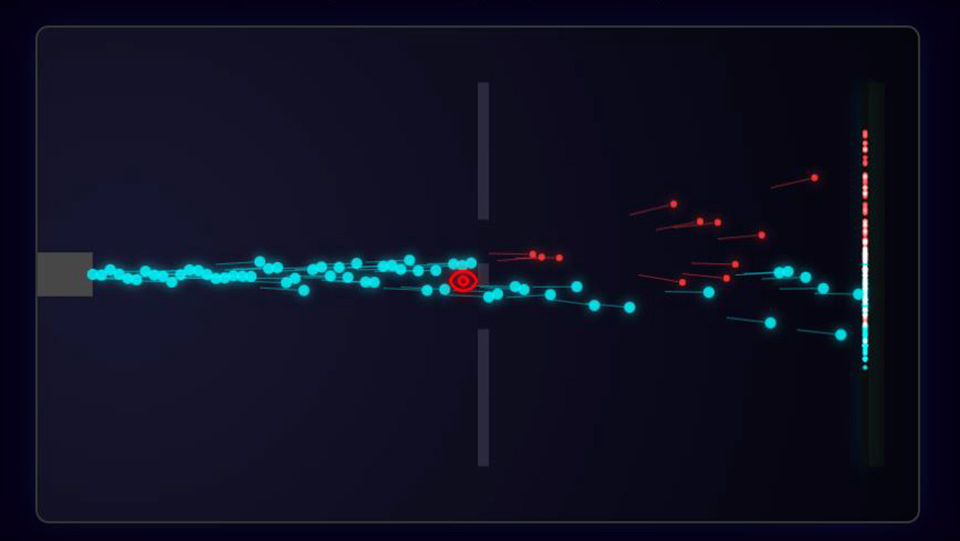
This is wave-particle duality — one of the cornerstones of quantum mechanics. An electron has no definite position until it is measured. When unobserved, it exists as a probability wave spread across space. The moment a measurement device tries to detect which slit the electron passes through, the wave function collapses: the electron becomes a particle again, and the interference pattern disappears.
The interactive simulation below lets you explore this directly. Watch the pattern build up on the detection screen as electrons accumulate. Then activate the measurement device and see what happens to the fringes.